

Please use this identifier to cite or link to this item:
https://hdl.handle.net/20.500.14356/3102| Title: | Suaahara II good nutrition program: evaluating a decade of multisectoral nutrition interventions: impact evaluation report |
| Authors: | Frongillo JR, Edward Joshi, Nira |
| Citation: | The Suaahara II Good Nutrition Program is supported by the United States Agency for International Development (USAID) under Cooperative Agreement No. AID-367-A-16-00006. |
| Issue Date: | 2021 |
| Publisher: | Helen Keller International |
| Keywords: | Suaahara Endline Survey Nepal |
| Series/Report no.: | ;RES01280_EDW_2021 |
| Abstract: | Suaahara, funded by USAID, is a comprehensive multi-sectoral nutrition program. Implemented in two phases – Suaahara I (2011-2016) and Suaahara II (2016-2022) – the program aimed to improve maternal and child nutrition in 42 of Nepal’s 77 districts. To achieve this goal, Suaahara delivered interventions in 3,353 wards/communities depending on local needs across nutrition, health and family planning, agriculture and markets, water, sanitation, and hygiene, and nutrition governance. Through these interventions, Suaahara aimed to achieve four Intermediate Results (IRs): IR1) Improved household nutrition, WASH, and health behaviors; IR2) Increased use of quality nutrition and health services by women and children; IR3) Improved access to diverse and nutrient-rich foods by women and children; and IR4) Accelerated rollout of Multi-Sector Nutrition Plan (MSNP) through strengthened local governance. Suaahara was extensively built upon government structures, community platforms and national programs to target marginalized and socially vulnerable groups. To evaluate the impact of Suaahara, a series of independent impact evaluation studies were conducted. This report presents each of the evaluation studies separately. Each evaluation was geared towards assessing the impact of Suaahara on each of the intermediate results (IRs) as outlined in the foreword. The evaluation of IR1 observed that Suaahara improved mother’s lives as manifested by improved maternal dietary diversity, weight, and rate of institutional delivery. Possibly reflecting improved prenatal conditions, the length of infants 0-5.9 months improved. Complementary feeding of infants and young children ages 6 to 23.9 months improved as reflected in improved dietary diversity, minimum acceptable diet, minimum meal frequency, and offering children more food when sick. Availability of soap and water at handwashing stations improved. These improvements in intervention districts relative to comparison districts were achieved despite substantial challenges Suaahara faced during the ten years of intervention. The evaluation of IR2 assessed Suaahara’s impact on health system strengthening. This evaluation observed that health facility workers and FCHVs in the intervention districts reported better knowledge on CB-IMCI, and GMP than in comparison districts. In terms of improved service delivery, the mean scores for service availability were higher in the intervention districts for maternal nutrition services, child nutrition services, ANC services, and FP services. Health facilities in intervention districts, compared to comparison districts, had better availability and use of reference materials and guidelines for GMP service, and counseling aids to provide nutrition assessment and GMP, FP, ANC, and PNC services. Also, a higher proportion of FCHVs from the intervention districts (36% vs. 4%) mentioned implementing the Self-Applied Technique for Health (SATH) approach in the mother groups they facilitate. In short, Suaahara interventions contributed to strengthen the health system across the two components (capacity building and improved quality service delivery). For evaluating IR3, two separate studies were conducted – quantitative and qualitative. The quantitative study aimed to understand the role of the HFP program in improving availability, accessibility, and consumption of diverse nutrient-rich foods in the marginalized and food insecure communities in Darchula. The evaluation observed that vegetable production diversity increased by 49% after the households received the HFP program. In addition, the likelihood of production of dark-green leafy vegetables and beans and pulses increased for the households after receiving the HFP program. Income from the sale of surplus vegetables was about USD 69 greater among the households after participating in the HFP program than before the program. Women’s knowledge on child nutrition and health improved after receiving the HFP program. Women were more empowered after being enrolled into the HFP program as indicated by their improved decision-making power over the use of income and the control of productive assets in the households. To substantiate the findings of the quantitative evaluation, a qualitative study was conducted in the same district (Darchula) with participating HFP members. This qualitative evaluation also observed that knowledge and practice related to homestead gardening improved among program participants. The knowledge HFP-participants had on consumption of nutrient-rich foods was also being translated into practice. For example, the knowledge and practice on child’s dietary diversity was quite high. The evaluation found the increased availability of nutrient-rich food at both household and community levels. There was increased income among HFP households through selling of surpluses which was largely due to growing off-season vegetables. However, a few barriers that prevented from yielding better results were lack of necessary materials (building fences, constructing semi-intensive coops etc.), lack of financial resources (purchasing polyhouses, purchasing materials for fence or coops etc.), lack of skilled manpower (installing polyhouses, constructing semi-intensive coops etc.) and lack of space (constructing semi-intensive coops, land availability to undertake tunnel farming etc.). The qualitative evaluation suggests that there’s need to establish strong linkages between farmers and local markets. Also, one of the key criteria for VMF selection should be based on their dedication and commitment for full engagement. The final part of the evaluation assessed Suaahara’s impact on improving multi-sector coordination for implementing the MSNP at the national, provincial, and municipal levels in Nepal. This study followed a rigorous qualitative design. The study observed that most multi-sector stakeholders understand their role in implementing the MSNP to promote nutrition in Nepal and can articulate specific programs within their sector that advances multi-sector nutrition activities. Suaahara II has positively contributed to building stakeholders’ capacity and facilitating an effective implementation of the MSNP, however challenges remain. Suaahara II has been particularly effective at promoting awareness for multi-sector roles, leadership, and coordination for promoting nutrition; demanding budgets for multi-sector nutrition activities; and nutrition-related concepts and practices across sectors and government levels. Suaahara II was effective at navigating and adapting to the shift to federalism and leveraging existing networks to strengthen their implementation of nutrition-focused activities, particularly at the local level. Yet, there exist gaps and challenges that hinder the effective implementation of the MSNP. Such challenges include insufficient human resources at the provincial level to adequately coordinate implementation at the municipal level and the lack of a formal reporting mechanism to enable provincial and municipal level stakeholders to effectively monitor progress towards goals and implementation activities. Additionally, the lack of a formal coordination mechanism hinders productive provincial and municipal level stakeholder collaboration, as does the limited capacity of available trained, technical specialists at the municipal level to design and implement activities. The study observed that the GoN heavy relied on Suaahara II to implement nutrition-focused awareness raising and promotion activities, to strengthen capacity building, facilitate multi-sector coordination, and to enable vertical coordination. Suaahara II was effective at reaching local communities to promote nutrition, as evidenced by the differences in nutrition knowledge and awareness reported by municipal-level stakeholders in intervention and comparison areas. |
| Description: | Research report. |
| URI: | https://hdl.handle.net/20.500.14356/3102 |
| Appears in Collections: | Approval Research Report (NHRC) |
Files in This Item:
| File | Description | Size | Format | |
|---|---|---|---|---|
| RES01280_EDW__2021.pdf | Download Research report for academic purpose. | 3.7 MB | Adobe PDF | 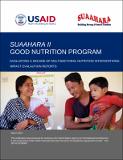 View/Open |
Items in DSpace are protected by copyright, with all rights reserved, unless otherwise indicated.